Last updated: September 2026
阅读中文版 (Read this article in Chinese)
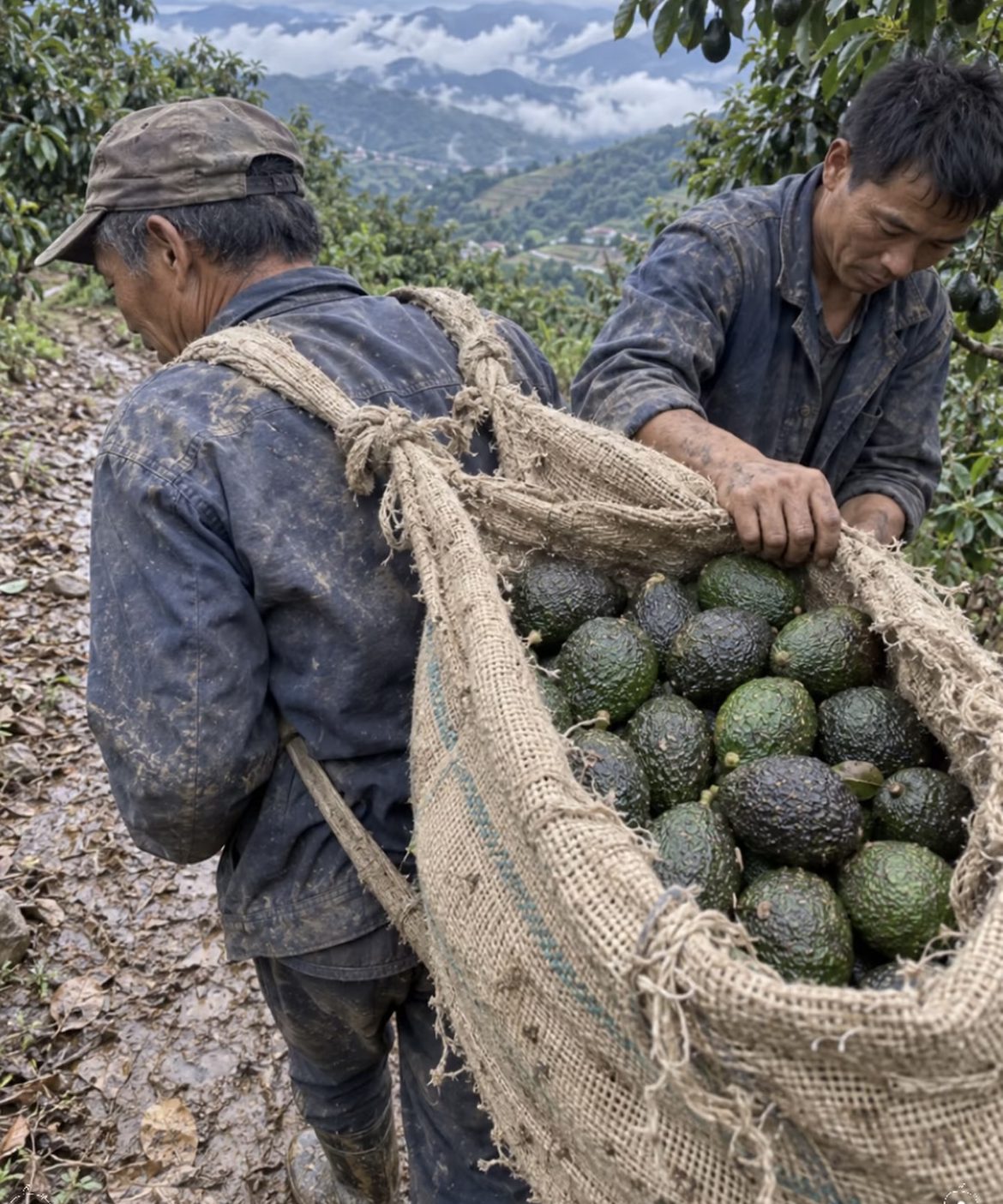
For most of the last decade, China’s avocado story has been an import story — foreign fruit, foreign ports, a supply chain measured in weeks at sea. That’s starting to change, but slowly and unevenly: domestic production remains small and geographically concentrated in Yunnan province, and not every part of Yunnan is equally suited to it.
The quality case for growing at home is straightforward. Chinese-grown fruit typically tests at 25–26% dry matter, against roughly 19–20% for a lot of the imported supply — the difference behind the rich, buttery texture consumers are learning to want. Domestic avocados can also be picked at 90%-plus ripeness, since they don’t need to survive a multi-week ocean crossing, versus roughly 70%-maturity for export fruit built to withstand transit; they can often reach a shelf within 48 hours instead of weeks.
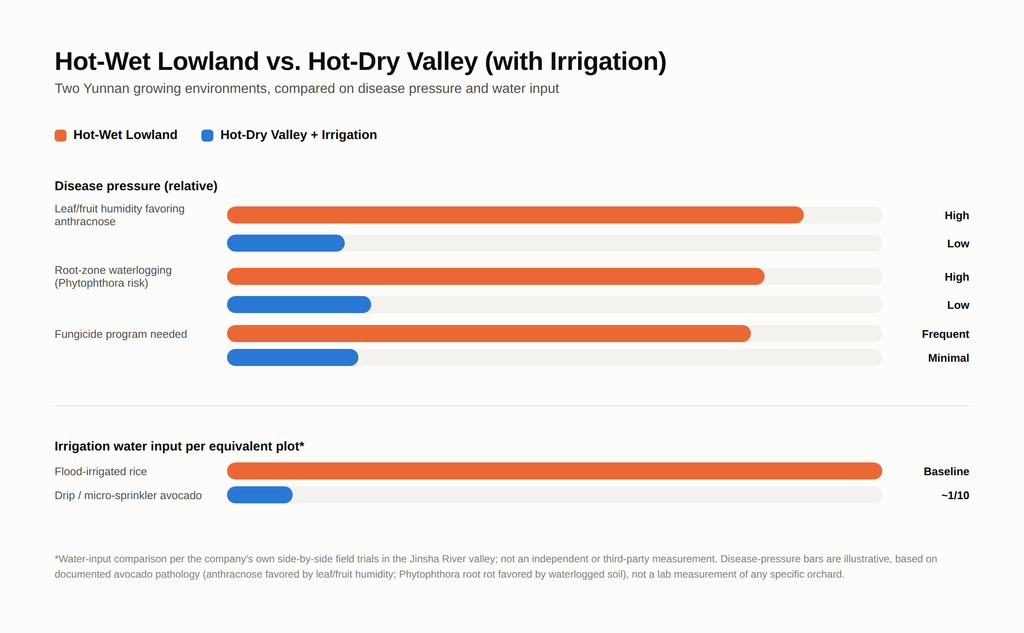
But “grown in China” isn’t one climate, and it isn’t one outcome. Avocado trees are unusually sensitive to two things: prolonged leaf and fruit humidity, which favors anthracnose, and waterlogged soil, which favors Phytophthora root rot — one of the crop’s most damaging diseases worldwide. Hot, wet lowland regions of Yunnan carry more of both pressures, and growers there typically need a heavier, more frequent fungicide program just to keep orchards productive.
Hot, dry valley climates carry much less disease pressure to begin with — there’s very little ambient moisture sitting on leaves or pooling in root zones — which means less need for that kind of intervention in the first place. The catch is that “hot and dry” only becomes an advantage with reliable irrigation: it takes deliberate water management to give trees what they need without recreating the wet conditions that cause disease. Get that balance right, and a hot-dry valley with controlled irrigation is arguably the closest thing to an ideal avocado microclimate that China has to offer — and growers in a handful of these valleys are starting to report fruit quality that surpasses what can be grown elsewhere.
One operation testing that thesis is 云南牛油果公司 (Yunnan Avocado Co.), which grows more than 15 avocado varieties in the Jinsha River valley near Lijiang and also works directly with new growers and investors evaluating whether to get into avocado cultivation — from assessing land and water access to sourcing proven varieties and setting up a young orchard correctly the first time.
“We’re so happy that Chinese consumers no longer have to choose B-grade avocados that have been on a ship for weeks or even months,” said Dr. Jonathan (江博士) of Yunnan Avocado Co. “Now consumers get access to premium, A-grade avocados that are tree-matured to their optimum oil content and harvested and shipped to the customer’s door within hours, not weeks. The difference is palpable.”
“We see Yunnan farmers have the ability to grow some of the most premium avocados anywhere, and to do it sustainably — protecting soil, water, and the surrounding environment.”
Water efficiency is part of that picture, too. In side-by-side field trials in their valley, the company found that avocado grown under drip and micro-sprinkler irrigation used as little as a tenth of the water required by flood-irrigated rice on an equivalent plot, while returning more usable calories per mu. Not every high-value crop is automatically water-hungry — and not every water-heavy crop is the most calorie-efficient use of that water.
The stakes are bigger than any one valley. Globally, avocados are on track to become the world’s most-traded tropical fruit by 2035, with exports forecast to reach 4.3 million tons and roughly $11 billion, overtaking pineapple. None of that makes Yunnan a threat to import volumes yet — China still brings in tens of thousands of tons a year from Peru, Chile, and a growing list of other suppliers. But as that import market matures past its early novelty phase and buyers get more selective about provenance and fruit quality, a hot-dry valley with the right water management and the right varieties is positioned to compete in a way that imported avocados can’t touch: quality at the very top of the market.
Yunnan Avocado Co. is featured in this piece — read more about the company and Dr. Jonathan (江博士) in his full bio.
A1: Yunnan spans very different microclimates. Hot, humid lowland areas create more favorable conditions for anthracnose and root disease; hot, dry valleys with controlled irrigation create fewer. The province label alone doesn’t tell you which environment a given avocado came from.
A2: It’s a soil-borne pathogen that thrives in waterlogged conditions and attacks avocado root systems — one of the most economically damaging avocado diseases worldwide. Good drainage and careful irrigation, rather than reliance on rainfall, are the main defenses. If the pressure is intense, growers often have no choice but to apply chemical treatments to keep their trees alive, which can lead to absorption inside the fruit that consumers eat.
A3: On freshness and ripeness-at-harvest, the data points that way: higher dry-matter content, higher ripeness at picking, and a much shorter time from tree to shelf. Quality still varies by grower and region — import volumes still dominate the market overall. Reviewers and consumers often describe domestically grown fruit as richer and less watery than the imported avocados many shoppers grew up with, consistent with its higher oil content.
Leave a Reply